Streaming, CD or Vinyl: Which Best Pays the Artist?
Love the album? Here’s what a CD, a vinyl record and 1,000 streams might put in the artist’s pocket—and why buying direct matters.
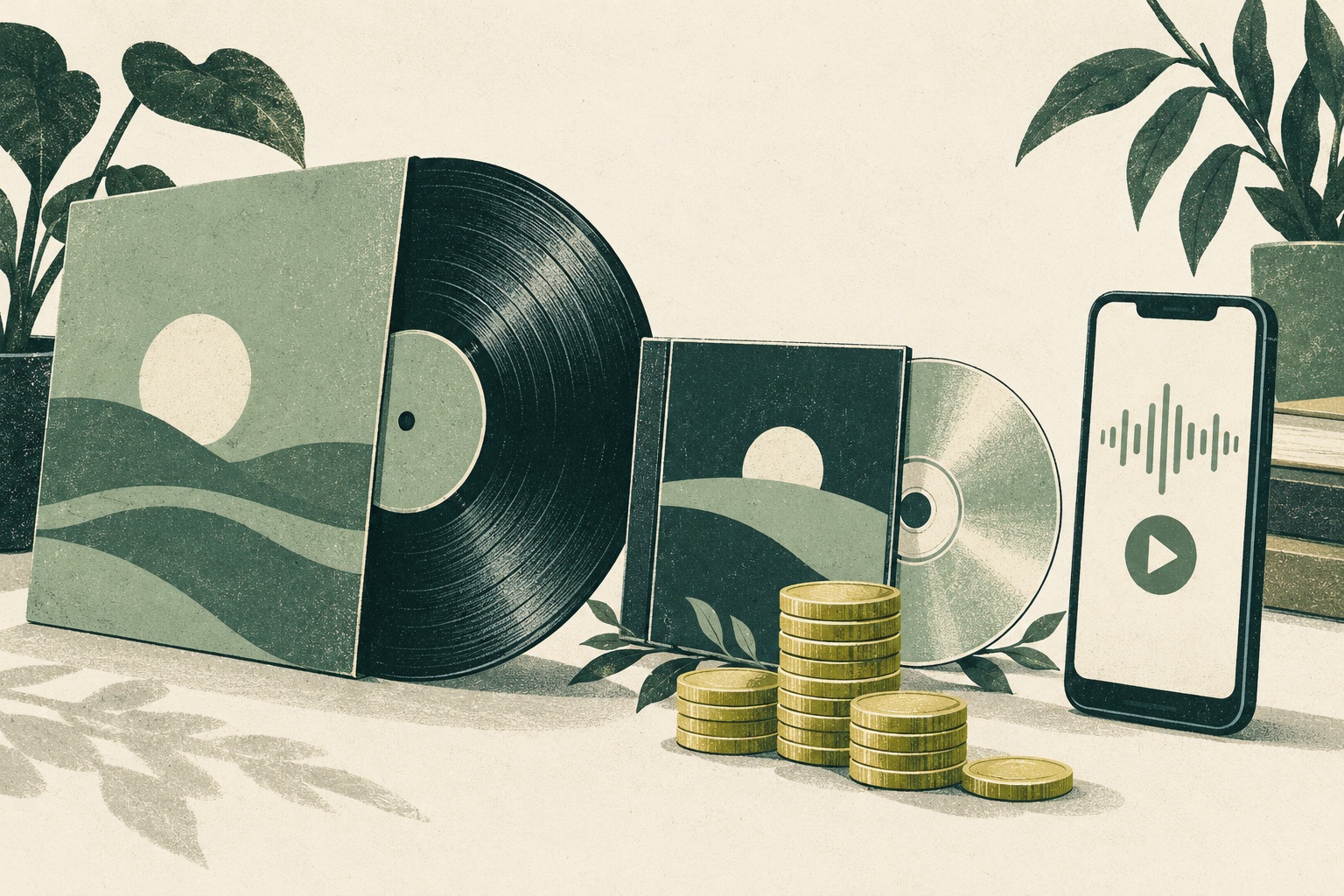
There’s an album you keep coming back to. You know the awkward little pause before track three, you’ve sent it to a friend, and somehow it still ends up on again while you’re making dinner.
At some point, just pressing play starts to feel like a fairly small thank-you. You want to put some money in the artist’s pocket. So what do you do: keep streaming, buy the CD, or spend a bit more on vinyl?
I’d start by checking where the artist sells their music directly. The format matters, but who gets your money matters more. A CD from the band’s own shop can be a better way to support them than a more expensive record sold under a less generous deal.
Streaming is wonderfully convenient. It’s also very good at making the price of an individual album disappear. You pay for access to an enormous library, and somewhere behind the play button a complicated chain of payments gets under way.
Spotify says about two-thirds of its music revenue goes into a royalty pool. That money is divided according to rights holders’ share of streams, then passed on to artists under their agreements. There isn’t one fixed amount paid for every play. Spotify explains the payment chain here.
That last bit is easy to miss. “This song generated $100” and “the artist received $100” are two different things. Someone releasing their own recordings can keep a much larger share than someone whose label owns them.
And it takes a lot of listening to add up. In a 2022 study using UK data from 2021, the Competition and Markets Authority estimated that an artist could earn roughly £12,000 from 12 million streams. That’s an older estimate, not today’s universal rate, but it gives you a sense of the scale. CMA study
None of that makes your listening pointless. Streams can keep earning over time, and they help people find music they might never have bought unheard. But if your aim is to give one particular musician a decent payment today, ordinary listening is a slow way to get there.
Artists have argued about this themselves, sometimes by taking their music off the services.
Taylor Swift withdrew her catalogue from Spotify in November 2014 over concerns about compensation and how the service valued music. It returned in June 2017. Her absence made the argument rather hard to ignore. Reuters on Swift’s return
Her 2015 dispute with Apple Music had a clearer practical result. Swift said she would withhold 1989 because Apple initially planned to pay no royalties during customers’ three-month free trials. After criticism from Swift and independent labels, Apple changed the policy and agreed to pay during those trials. Reporting on Apple’s reversal
Thom Yorke and Nigel Godrich made their own protest in 2013, removing Yorke’s The Eraser and Atoms for Peace’s Amok from Spotify. Their complaint was especially about new artists: how were they supposed to fund the next record if the current one paid so little? Pitchfork on the withdrawal
Adele took a different route. You could buy 25 in 2015, but the album didn’t arrive on streaming services until mid-2016. That gave CDs and downloads a head start. It was a temporary window for sales, rather than a permanent streaming boycott. Official Charts on the release
Withholding music can mean giving up income and listeners too. Those examples show ways to push for better terms or protect sales; they don’t prove that every artist would make more by leaving streaming.
Which brings us to the slightly unfashionable, very useful CD.
CDs can be relatively cheap to make. As one supplier example, Disc Makers advertises packages of 100 CDs in printed jackets starting below $2 a disc, while its entry vinyl runs of 100 records start below $1,000. Those are starting prices for specific packages, not industry averages. Still, the difference helps explain why a modestly priced CD can leave a healthy amount after manufacturing. Disc Makers’ manufacturing information
For someone selling their own music, that matters. A fan doesn’t have to spend €35 on a record to make a useful contribution. A cheaper CD bought directly can do a lot of good.
Vinyl has a case too, of course. A higher selling price can leave more money per copy. The catch is that pressing the thing, making its sleeve and getting it to the buyer also costs more. The price sticker isn’t the artist’s earnings.
So lets put some actual numbers beside each other. These are illustrative direct sales by an independent artist who owns their recordings, with no selling commissions or payment fees. All amounts in the table are US dollars.
For the CD, assume a $15 sale and $3 manufacturing cost. For vinyl, assume a $30 sale and $12 manufacturing cost.
Format | Artist keeps* | Streams to match* |
|---|---|---|
CD, bought directly | About $12 | About 3,500 |
Vinyl, bought directly | About $18 | About 5,300 |
1,000 song streams | About $3.40 | 1,000 |
*Amounts are before other expenses and assume no distributor commission. The stream equivalents use $3.41 per 1,000 individual song plays, rounded to the nearest hundred. They’re song plays, not full-album listens. Taxes, recording and marketing costs, and any publishing or collaborator payments still have to be accounted for. Shipping is assumed to be paid separately.
The streaming number comes from Duetti’s 2024 data on recording royalties. Services paid different amounts, so $3.41 is a historical benchmark, not a promise about what an artist receives now. The real number of streams needed could be higher or lower. Duetti’s report announcement
In our example, the vinyl sale leaves more cash. The CD leaves a bigger proportion of its selling price after manufacturing. Both can be worthwhile. Neither figure is final profit, and an artist sitting on boxes of unsold records has already paid for stock that hasn’t paid them back.
The bit I’d pay most attention to is the shop.
Buying from the artist’s own website or merch table can let them keep the retail margin. There may still be payment fees, shop expenses or a venue commission. And an “official store” can be run by a label or merchandise company, so the logo alone doesn’t tell you who keeps what.
Bandcamp makes its platform cut fairly easy to understand: normally 10% on physical goods and 15% on digital music, with the digital rate dropping to 10% after qualifying sales reach its threshold. Payment processing and other applicable deductions come separately. The seller gets the remaining proceeds—and that seller might be the artist, or a label. Bandcamp’s fees
There’s also the contract. The Musicians’ Union explains that artists’ royalty terms vary, and advances can be recovered from recording income. A purchase might therefore help pay down an advance before it generates another payment to the musician. An expensive deluxe edition doesn’t magically get around that. Musicians’ Union guidance
And if you don’t actually want another object on the shelf, buying a download directly is a perfectly good option. There’s no disc to manufacture or parcel to post. If the artist offers a pay-what-you-want price, a tip or a membership, you can put your money there instead.
My own pick? A direct purchase of something you’ll enjoy. A CD if that suits your budget. Vinyl if you love having the record and can comfortably spend more. A download if you’d rather skip the extra stuff.
Then keep listening however you like. You don’t need to turn enjoying music into homework. But when an album really stays with you, buying it from the person who made it is a pretty good thank-you.